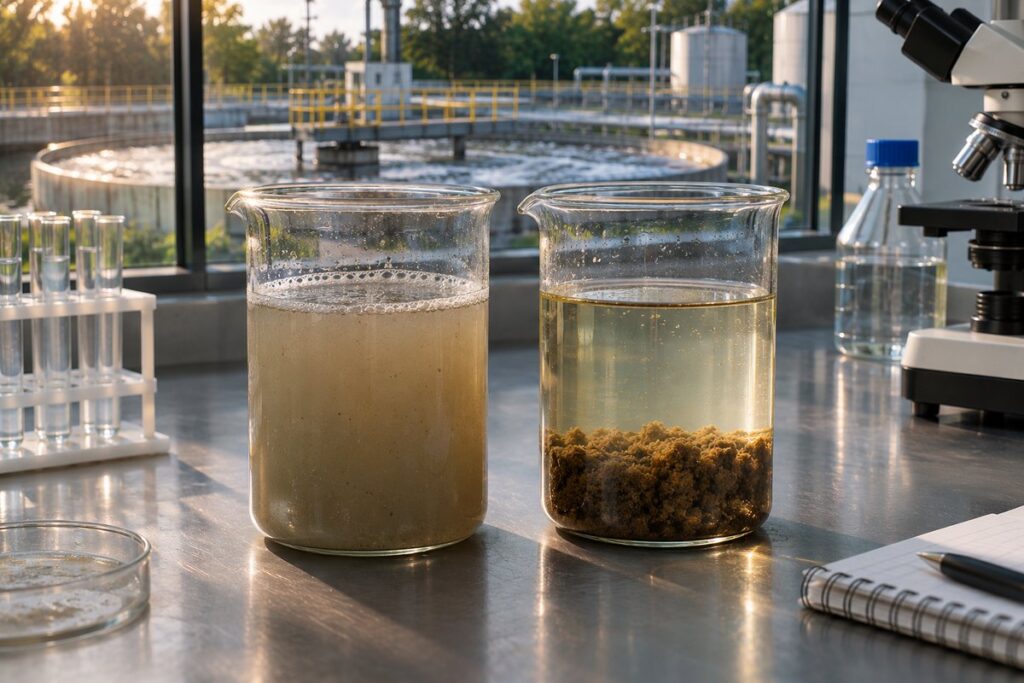
The most consequential decision in a city’s cannabis monitoring program can be made before a sample reaches the instrument. An analyst separates the cloudy material from incoming wastewater and keeps the clearer liquid. That makes a difficult sample easier to handle. It can also send part of the signal the city wants to measure into the discarded particles. In one investigation, the fraction associated with solids varied from 8 to 69 percent.
The chemical riding into the treatment plant
Wastewater researchers interested in cannabis commonly measure THC-COOH, a metabolite the body forms after exposure to THC. The choice of a metabolite matters. Its presence provides a closer connection to human consumption than measuring plant material that someone might simply have washed down a drain. Even so, the plant receives a highly diluted and chemically complicated mixture, collected after the metabolite has traveled through a network of pipes with everything else in the sewer.
At the inlet, the sample is neither plain water nor a uniform solution. Fine material carried along in the flow provides surfaces with which molecules can associate. A laboratory can measure the liquid fraction, the suspended material or both. The fractions have to be expressed on a common basis before anyone can add them. A concentration per gram of suspended material must be multiplied by the amount of that material in the original volume of wastewater.
How much did the filter catch?
In a study of THC-COOH partitioning, Natan Van Wichelen and colleagues examined how the metabolite was distributed between these fractions. The share found in suspended material varied considerably, and the concentration of suspended particles influenced the distribution. The investigators also observed that transfer could happen in both directions. A particle need not permanently retain every molecule that was associated with it when the wastewater first entered the collection bottle.
Consider two hypothetical samples that each contain 100 units of the metabolite per liter in total. If 10 units are on particles in one bottle and 60 in the other, a liquid-only test reports 90 and 40. A chart made from those results would show more than a twofold difference. The population could have contributed exactly the same amount in each case. The numbers are illustrative, but the observed spread in the fraction held by solids makes the concern quite real.
From the bottle to the whole catchment
To move from concentration to a daily load, investigators also need to know how much wastewater flowed into the plant. To express the result per thousand residents, they need an estimate of the population served. The European Union Drugs Agency’s guide to wastewater epidemiology describes these steps. Multiplying a liquid-only concentration by the correct daily flow still leaves out the material removed in the laboratory.
A review of cannabis wastewater surveillance considers further difficulties, including the relationship between the amount consumed and the amount ultimately available for measurement. Moreover, the same citywide load could come from frequent use among a smaller group or occasional use among many people. A chemical measurement cannot supply the head count that would distinguish those explanations.
A better question to ask of a city chart
The European multi-city wastewater study publishes data that allow readers to compare places and years. Before reading a rise or fall as a change in community behavior, it is worth checking what laboratories collected, which fraction they analyzed and whether the method stayed the same. Comparability improves when the methods accompanying a number are as visible as the number itself.
Citywide monitoring is attractive precisely because a single location can gather evidence from so many people. The awkward detail is that some of their collective signal arrives attached to particles. What happens to those particles on a laboratory bench can shape the story subsequently told about an entire city.